
This is what taxpayers must know about mutual fund equity-linked saving schemes

Ask rediffGURU Reetika Sharma your insurance, mutual fund and personal finance-related questions.

Many investors are lured with dividends that mutual funds pay, without realising that they are getting their own money back.
Our advice for investors -- opt for funds like HDFC Long Term Advantage and HDFC TaxSaver which have proven track records to show for, over longer timeframes.

Equity linked saving schemes, ELSS, became popular because they saved you taxes. Now the same ELSS funds have shown that investors can make money as well.
This is an equity diversified fund and investors enjoy both the benefits of capital appreciation, as well as tax benefits.
Do you know of some good equity linked saving schemes that will not only help you save taxes but give decent returns. Get Ahead tax expert Mahesh Padmanabhan tells you about these and how to plan to save your taxes.
To select the right fund, investors need to first evaluate their risk profile and also assess the funds on parameters like the investment style, performance and risk, among others.
Equity linked saving schemes not only help you save tax but also give decent returns. Here's the list of top 10 ELSS funds for the year ending February 8, 2008.
Equity linked saving schemes of mutual funds help investors not only save tax but also make money.
Here's the list of top 10 tax saving mutual funds for the period between November 28, 2006 and November 27, 2007. Their gains far outperform the gains made by the Sensex during the given period.

Majority of equity linked savings schemes as well as mid and small-cap funds outperformed their respective benchmark indices over a five-year period ended December 2015.
Here's a list of Top 10 ELSS funds in terms of percentage gain in the last one year till August 10, 2007. These funds not only help you make money but also save taxes as per Section 80C.
The season for investment in tax saving instrument has started. Here, is an investment avenue to save tax that is cheap and lets you participate in India's economic growth story.
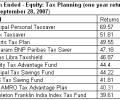
Mutual funds, especially the tax saver variety seems to be on a roll. Here's the list of top 10 ELSS mutual funds for the period ending September 28, 2007. These ELSS funds have made more money for you than the Sensex gains.
Here are some key parameters that need evaluation before you select the right tax-saving fund.
If you want to be a smart investor, you cannot view your investments solely on the basis of the returns they can generate.
Do not put all your funds into a single scheme; have a mix of fund houses as well as schemes.
Try this mutual fund quiz to figure out how savvy you are about this investment option.

As per the latest data available with mutual fund industry body AMFI, the total AUM of ELSS, or tax-saving funds, stood at Rs 25,069 crore at the end of January 2013.
With domestic markets turning choppy, investors are increasingly scouting for opportunities overseas to diversify portfolios and hedge against a weakening rupee.

NPS Vatsalya offers a disciplined investment avenue that parents can use to create intergenerational wealth by contributing even small sums.

AI isn't a magic wand. It works best when combined with good systems, informed investors, and skilled advisors, says Amit Suri.

'The decline was inevitable as one-year returns have been negative.'

Investors with a long-term horizon and high-risk appetite seeking capital appreciation can consider investing in ELSS.

Tax-saving investments should not be made with the sole purpose of saving tax, but should also help an individual grow his wealth, suggests Archit Gupta, founder and CEO, ClearTax.
Should taxpayers invest in Rajiv Gandhi Equity Saving Scheme to save tax? How much tax will they actually save? And what are the pros and cons you should check out before going for this scheme? Salil Dhawan offers his take.

Restoring weighted tax deductions and adopting a petty patents regime can foster firm-level innovative activity critical for competitiveness, points out Nagesh Kumar.
Anamika Pareek explains the advantages of investing in tax-saving options like the equity-linked savings schemes.

Don't solely focus on tax-saving alone.

ELSS investments require a long-term commitment of at least seven years.

The regulator has sought an increase in the investment limit for tax-saving equity mutual fund schemes to Rs 200,000 from the current Rs 150,000.

A neutral monetary policy stance, heavy government borrowing, and issuers adjusting to a higher-for-longer yield environment have set the stage for a largely stable corporate bond market in 2026.
They give you tax sops on investments and are also exempt from long term capital gains tax.
There are many questions investors are asking their financial advisors at the moment.
